Literacy7 min read

There are no stem cells in stem cell skincare. What is in the bottle is the set of proteins and signals those cells released while they were growing, and knowing that changes what you should reasonably expect from it.

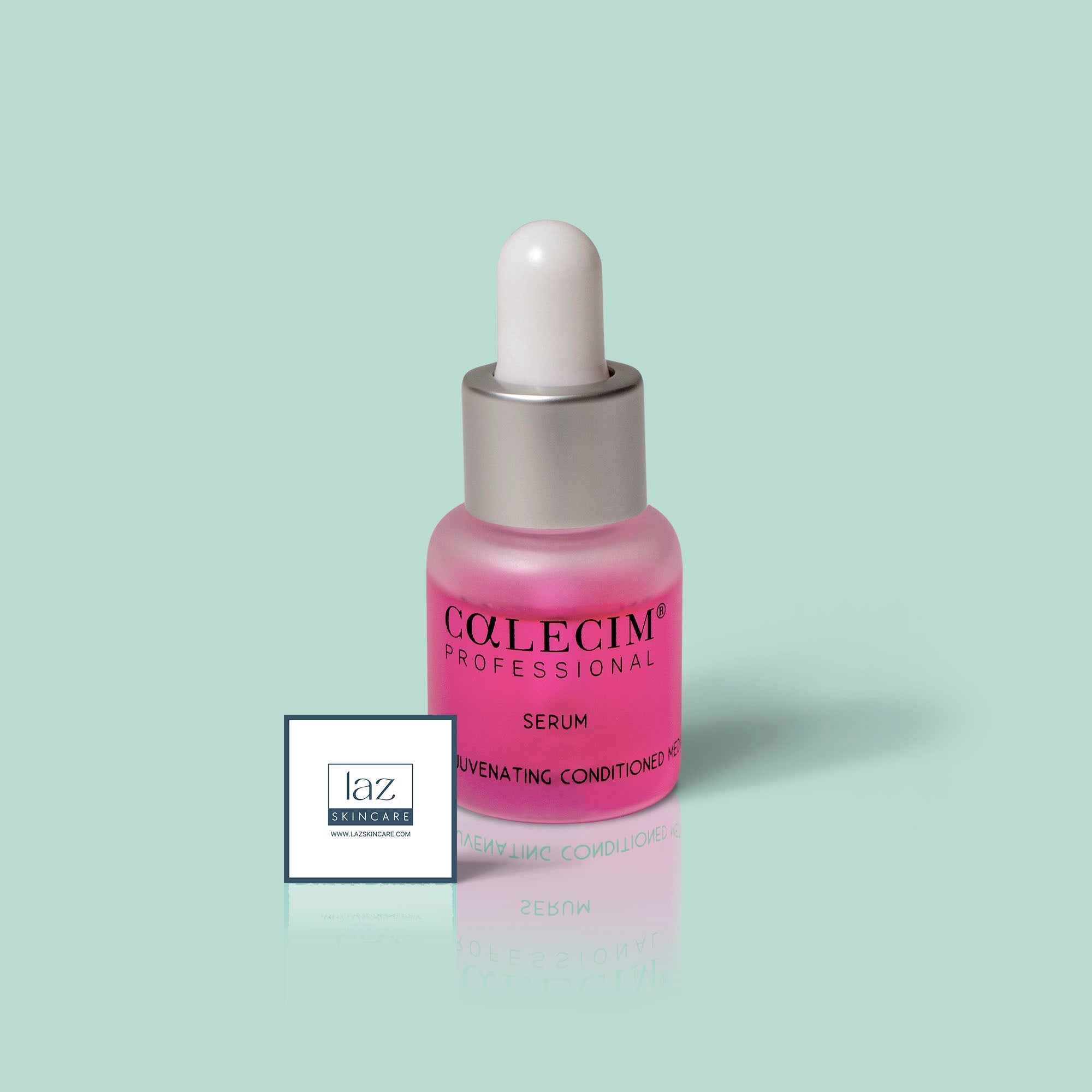
The Calecim Professional Serum, stocked by LAZ Skincare.
A good serum, and a considerably better adjunct to a treatment.

The short answer

The Calecim Professional Serum is the regenerative serum I reach for around treatments. Conditioned media carrying growth factors and structural proteins, with hyaluronic acid and albumin handling the immediate surface, and no irritation or downtime attached to any of it.

A pipette to the whole face, before your other products.

Here is my honest position. This is at its most useful in the hours and days after microneedling or a laser, when the skin is permeable and actively repairing. On fully intact skin the same molecules have a much harder job getting anywhere, and the manufacturer's own directions half admit it by leading with the procedure protocols. It is a good serum. It is a considerably better adjunct.

What does stem cell skincare actually contain?

Conditioned media. Cells are grown in a nutrient solution, they secrete proteins and signaling molecules into it while they grow, and that liquid is filtered and formulated. The cells themselves are not in the product and would not survive there.

This matters because the marketing language invites people to imagine something far more dramatic than what is happening, and then to be disappointed by a perfectly reasonable result.

What the secreted material contains is worth taking seriously on its own terms:

  • Growth factors, which are the proteins that tell fibroblasts to produce collagen and elastin.
  • Cytokines, which coordinate how the skin handles repair and inflammation.
  • Structural proteins the skin uses as raw material rather than instruction.

The open question with all of them is delivery. Growth factors are large molecules and intact skin is very good at keeping large molecules out. That is not a reason to dismiss the category. It is the reason the timing of application matters more here than with almost anything else on your shelf.

The Calecim Professional Serum from the LAZ Skincare range.
One pipette, first, against the skin rather than under three other things.

Do growth factor serums work for fine lines?

They help, modestly, and they help considerably more when the skin has been opened by a treatment first. Anyone promising results comparable to a retinoid from a growth factor serum alone is overstating it. The Calecim Professional Serum has an unusually short ingredient list, which makes it easy to see what you are actually buying.

PTT-6 is the conditioned media component, a blend of growth factors, cytokines and proteins intended to reproduce the signaling environment of skin that is actively repairing itself. This is what you are paying for and everything else supports it.

Soluble collagens, fibronectins and glycoproteins are structural proteins. Fibronectin in particular is involved in how cells organize themselves during repair, which is why this formula is oriented around treatment recovery rather than daily maintenance.

Albumin tightens the surface as it dries. This is a real effect and a temporary one, and it is worth naming so you do not mistake it for the serum working overnight.

Hyaluronic acid draws water in and plumps the surface, softening the look of fine lines from the first application.

Seven ingredients in total. There is no fragrance, no oil and nothing to irritate, which is exactly what you want on skin that has just been treated.

When does a regenerative serum work best?

Immediately after a controlled injury. Microneedling, a peel or a laser leaves skin permeable and mid-repair, which is precisely the window where signaling proteins can reach cells that are listening for them. Clinics use it to reduce downtime, swelling and discomfort as much as to improve the final result.

One client in her forties told me her skin had lost its snap. There were no significant wrinkles, just a general tiredness to the whole face. We put this into her nightly routine and supported it with gentle in-clinic treatments. Within a month her cheeks looked subtly lifted, the fine lines had softened, and the skin looked fresher.

Note the treatments alongside it. I am not going to pretend the serum did that alone.

Who it does not suit: anyone wanting the strongest available result from a daily routine, who should be on a retinoid. Anyone with established laxity, which needs energy devices. And anyone who never has professional treatments, for whom the value proposition here is genuinely weaker.

Calecim Professional Serum, part of the LAZ Skincare range.
Seven ingredients. Nothing to irritate skin that has just been treated.

What to do

  1. Clean, dry skin, morning and evening. One pipette across the whole face.
  2. Apply the Calecim Professional Serum first, before every other product. It needs to be against the skin, not layered under three other things.
  3. Moisturizer or sunscreen over it in the morning, a richer cream at night.
  4. Keep the rest of the routine simple. This is not a serum to stack actives on top of.
  5. If you have microneedling, a peel or a laser booked, use it straight after and for the following few days. That is the highest-value moment it has.

Follow your practitioner's instructions after any clinical treatment rather than mine, since protocols differ.

Softness and visible firming at three to four weeks, with slow continued improvement after that. Some of the early tightening is albumin on the surface rather than anything structural, so judge it properly at eight weeks.

Sources and further reading

Product discussed: Calecim Professional Serum. Stocked because it is used in the clinic. The full ingredient list and current details are on the product page.

Whether a regenerative serum is worth it for you depends almost entirely on whether you are having treatments alongside it. Book a consultation, in person at the NYC clinic or virtually, and I will tell you honestly whether it earns a place in your routine.

Last reviewed