9 min read

Eczema tends to return in the same places, and every round of scratching weakens your skin barrier and makes the next flare easier to start. Moisturizing every day strengthens that barrier, and it matters just as much between flares, when your skin looks clear, as it does during one. Alongside your doctor's care, it is one of the most helpful things you can do to break that pattern.

The short answer

Eczema is a long-term condition in which the skin barrier is weaker than average, the skin's immune response is stronger, and itch leads to scratching that damages the barrier further. It is manageable. Skincare's part is a short, fragrance-free routine, moisturizing every day, between flares as well as during them, and knowing your own triggers. That works alongside whatever your doctor prescribes for flares.

Read time 9 min
Suits Dry, Sensitive, All skin types

What eczema is

Atopic eczema is very common, especially in children, and many children find it becomes milder as they grow up. It can also continue into adulthood or start for the first time later in life. Atopic describes a tendency to react strongly to everyday things, which is why eczema often runs in families alongside asthma, hay fever and food allergies.

It shows up as dry, itchy patches that flare and settle. In babies, it often starts on the cheeks and scalp. In older children and adults, it is more common in the creases of the elbows and knees, on the hands and neck, and around the eyes. On lighter skin a flare looks red. On deeper skin tones it can look darker brown, purple or gray, which makes it easier to miss.

Why the barrier is weaker

The top layers of your skin keep water in and irritants out, with fats holding the skin cells together and a thin layer of oils and fats on the surface to stop water evaporating. In eczema, that barrier is weaker from the start.

Many people with eczema carry a change in the gene for a protein called filaggrin. Filaggrin helps hold the top layer of skin together, and as it breaks down, it becomes part of the skin's own moisturizing factor, the small molecules that hold water inside skin cells. With less filaggrin, skin loses water faster and lets irritants and allergens in more easily. Skin with eczema also tends to have fewer ceramides, which are the main fats between skin cells.

Not everyone with eczema carries the filaggrin change, and not everyone who carries it develops eczema. What they share is a barrier that needs more support than average, every day.

The itch and scratch cycle

Itch is the symptom that drives eczema. Scratching damages the barrier, a damaged barrier loses more water and lets more irritants in, and that causes more inflammation, which makes the skin itch more.

Because of that cycle, a well-supported barrier matters: it lets fewer irritants in.

Common triggers

Triggers differ from person to person, and most people have more than one. Cold, dry weather and indoor heating dry the skin. Heat and sweat can set off itch. Soaps, fragrance and some preservatives can irritate skin with eczema, and so can wool, rough fabrics and long, hot baths and showers.

For some people, dust mites, pollen or pet hair play a part, and stress and poor sleep make most flares worse.

Diagram of a circular cycle in which itch leads to scratching, scratching to a damaged barrier, a damaged barrier to inflammation, and inflammation back to itch.
Scratching damages the barrier, and the inflammation that follows makes skin itch even more.

How to manage eczema with skincare

Moisturize every day, including between flares

Moisturizing is the part of eczema care you do yourself. A large review of 77 trials found that people who moisturized had fewer flares and needed less of their prescribed steroid cream, and that a moisturizer used together with a prescription worked better than the prescription alone.

Apply your moisturizer at least twice a day, and again after every bath or shower. Applying it within a few minutes of bathing, on slightly damp skin, helps it spread. Thicker creams and ointments hold water in longer than lotions, and they suit eczema well, especially at night.

Choose a fragrance-free moisturizer with barrier ingredients

Look for a fragrance-free moisturizer that contains one or more of these. Each one has its own article in the Ingredients that help section below.

Ceramides, cholesterol and fatty acids are the barrier fats eczema skin tends to be short of. Replacing all three, in balance, helps it hold water in.

Ectoin holds water steady around your skin cells and calms irritation. In a small four-week trial in children with mild to moderate eczema, a cream with ectoin and hyaluronic acid improved the eczema more than a plain cream did.

Panthenol is vitamin B5. It hydrates, calms irritation and helps skin repair.

Niacinamide helps your skin make more of its own ceramides. Look for a lower strength, around four to five percent, since higher strengths can sting skin with eczema.

Sodium hyaluronate draws water into the top layers, and it works best under a moisturizer with oils and fats to hold that water in.

Squalane is a light oil similar to one your skin makes itself, and it helps slow water loss.

Probiotics, prebiotics and postbiotics support the balance of bacteria on your skin. Skin with eczema often carries more of one type, called Staphylococcus aureus, and a smaller range of the others, and these ingredients aim to even that out.

The ingredients above are barrier ingredients, which means there is no need to wait until a flare has settled to start them. If your doctor has prescribed a cream for flares, use it as directed, and ask them how long to leave between it and your moisturizer.

A microbiome serum we recommend

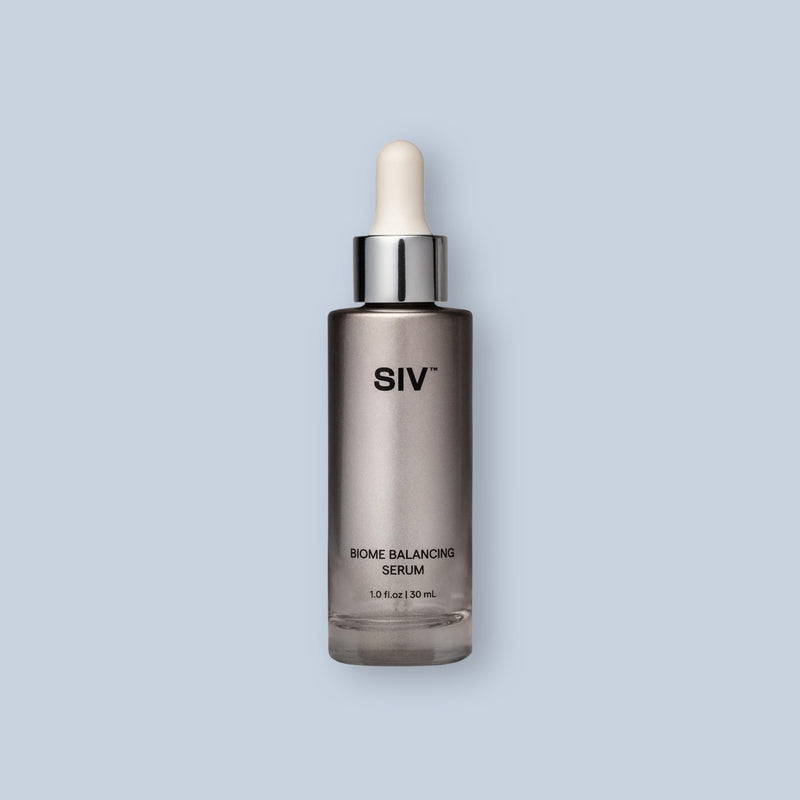
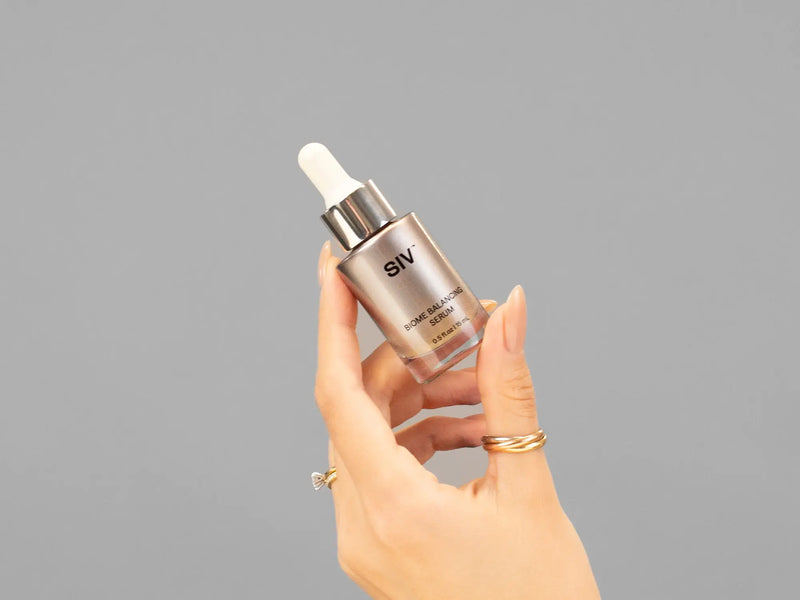
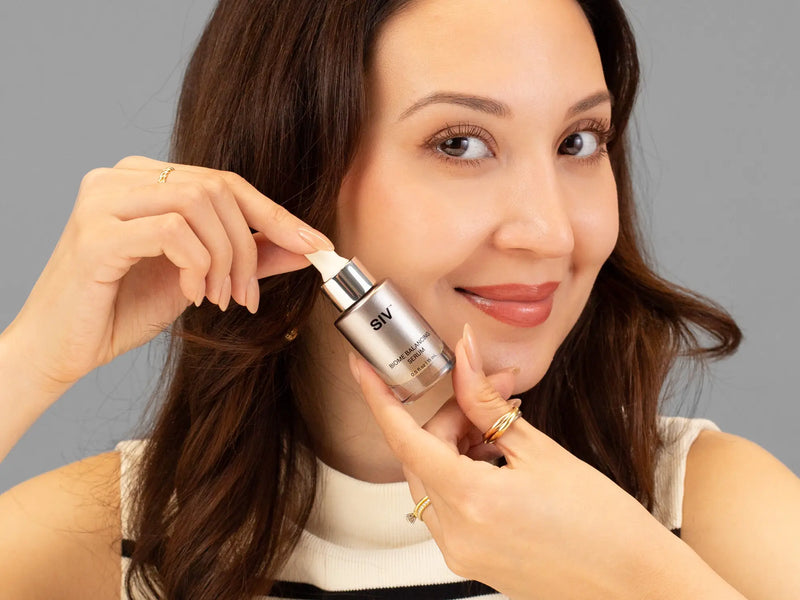
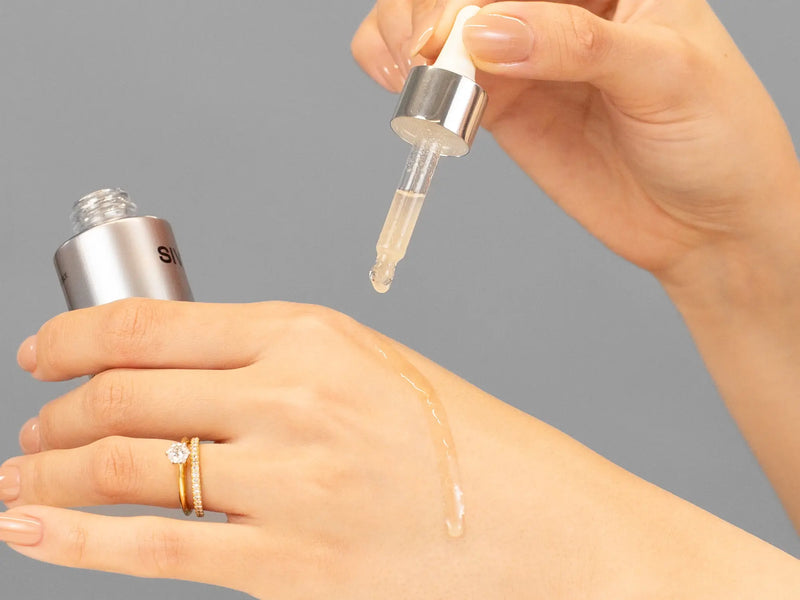
For clients with eczema, we often recommend the SIV Biome Balancing Serum. If a doctor is managing your eczema, check with them first. The serum contains dormant Bacillus spores, a type of bacteria that becomes active with the warmth, oils and water on your skin. It is designed to rebalance the bacteria on your skin, including the Staphylococcus aureus that skin with eczema often carries too much of.

Research on Bacillus found that a compound it makes interferes with the signals Staphylococcus aureus relies on to settle and grow. That research was in the gut rather than on skin, and the serum itself has no published study yet. In our clinic, we see skin with eczema become calmer and more resilient with it. Apply it once a day before your moisturizer, and keep it off broken or weeping skin. Use it on different days from hypochlorous acid, which reduces every kind of bacteria and can kill the spores.

Keep bathing short and lukewarm

Hot water strips the oils your barrier relies on, and long soaks dry skin out. Use a gentle, fragrance-free cleanser rather than soap, cleanse only the areas that need it, and moisturize straight afterwards.

Sunscreen every morning

Mineral sunscreens with zinc oxide or titanium dioxide are often more comfortable on skin with eczema, because the filters settle into the topmost layer of skin and stay there. The right sunscreen for you is the one you will actually apply every morning and reapply throughout the day.

Diagram comparing a barrier with gaps, where irritants get in and water escapes, and a barrier under a layer of moisturizer, where irritants stay on the surface and water stays in.
Moisturizing every day, including between flares, helps keep your barrier sealed and the itch less likely to start.

Common questions

How long until moisturizing makes a difference?

Most people notice less dryness and itch within one to two weeks of moisturizing twice a day. Fewer and milder flares show up over two to three months of steady use.

Around week three, once skin looks clear, is when people tend to stop moisturizing, and that is usually when the next flare arrives. Keep going between flares. The photo routine in the How to use it section below makes the progress easier to see.

Will my eczema go away?

No, not always. Many children find their eczema becomes much milder as they grow, while for others it continues or returns in adulthood. Skincare does not make eczema go away. It makes flares less frequent and easier to settle, and that is very achievable.

Can I use retinoids or exfoliating acids?

No, not on skin with active eczema. On areas that are clear, some people with eczema can use them, starting two nights a week and stopping if the skin stings. If a doctor is managing your eczema, ask them first.

Does eczema leave marks on deeper skin tones?

Yes, it can. Deeper skin pigments much easier, and eczema can leave darker or lighter patches behind once a flare settles. These marks usually fade over months as the skin renews, and keeping flares short and scratching to a minimum helps prevent new ones.

Can I use these ingredients during pregnancy?

Yes, most of them. Ceramides, panthenol and niacinamide are commonly used during pregnancy, and most retinoids are avoided. Eczema can change during pregnancy, and skincare ingredients are almost never tested on pregnant people, so check anything new with your OB or midwife, and any prescription with the doctor who gave it to you.

How to use it

  • Moisturize at least twice a day and after every bath or shower, including between flares, when your skin looks clear.
  • Choose fragrance-free products, and keep your routine short.
  • Keep baths and showers to ten minutes or less, in lukewarm water, and pat your skin dry.
  • Keep your nails short, and press or hold a cool, damp cloth on an itchy patch rather than scratching it.
  • Note what happened in the day or two before each flare, to find your own triggers.
  • Patch test anything new on a small area for three to five days before using it more widely.
  • Photograph your skin on day one, in the same spot and in natural daylight, and again every four weeks.
Start with the basics Skincare 101: Know Your Skin, Build Your Basics
Evidence and sources
  • Zettersten EM, Ghadially R, Feingold KR, Crumrine D, Elias PM. Optimal ratios of topical stratum corneum lipids improve barrier recovery in chronologically aged skin. Journal of the American Academy of Dermatology, 1997. How the balance of ceramides, cholesterol and fatty acids applied to the skin changes how quickly the barrier recovers. Read the study
  • Palmer CNA, Irvine AD, Terron-Kwiatkowski A, et al. Common loss-of-function variants of the epidermal barrier protein filaggrin are a major predisposing factor for atopic dermatitis. Nature Genetics, 2006. The filaggrin gene change and its link to eczema. Read the paper
  • van Zuuren EJ, Fedorowicz Z, Christensen R, Lavrijsen APM, Arents BWM. Emollients and moisturisers for eczema. Cochrane Database of Systematic Reviews, 2017. The review of 77 trials described above, on flares and steroid use. Read the review
  • Harrison IP, Spada F. Breaking the Itch-Scratch Cycle: Topical Options for the Management of Chronic Cutaneous Itch in Atopic Dermatitis. Medicines, 2019. The itch and scratch cycle, and lower ceramide levels in eczema skin. Read the review
  • Alexopoulos A, Dakoutrou M, Nasi L, et al. A randomized, observer-blind, vehicle-control, multi-center clinical investigation for assessing the efficacy and tolerability of a 1% ectoine and hyaluronic acid 0.1%-containing medical device in pediatric patients with mild-to-moderate atopic dermatitis. Pediatric Dermatology, 2022. The four-week ectoin trial in 57 children described above. Read the study
  • Piewngam P, Zheng Y, Nguyen TH, et al. Pathogen elimination by probiotic Bacillus via signalling interference. Nature, 2018. A compound made by Bacillus blocked the signaling Staphylococcus aureus uses to colonize the gut. Read the study

A note on the evidence. The weaker barrier in eczema, and the benefit of daily moisturizing, are well established. The moisturizer review found no reliable evidence that one moisturizer is better than another, many of the trials were small, and many were funded by the companies making the products. The itch review was written by authors who work for a company that makes eczema products. The ectoin trial was small and short, tested ectoin together with hyaluronic acid, and was funded by the company that made the cream. What we describe here combines that research with what we see in the clinic.

Last reviewed

Ingredients that help

What each one does, how it works and how to use it.

Products for Eczema

  • Biojuve

    Biojuve Travel Kit

    4.5 out of 5.0 stars

    $70.00

  • SIV

    Biome Balancing Serum

    4.8 out of 5.0 stars

    From $68.00

  • Biojuve

    Biome Support Complex

    4.9 out of 5.0 stars

    $150.00

  • Hale & Hush

    $34.00

  • Vivant

    $72.00

  • Hale & Hush

    $98.00

  • Epicutis

    Hydrobiome Mist

    4.8 out of 5.0 stars

    $75.00

  • Epicutis

    Hydrobiome Serum

    5.0 out of 5.0 stars

    $165.00

  • Young Goose

    $151.50

  • Epicutis

    Hyvia Creme

    4.9 out of 5.0 stars

    $195.00

  • GlyMed

    Illuminating Cleansing Oil

    5.0 out of 5.0 stars

    $49.00

  • Epicutis

    Lipid Serum

    5.0 out of 5.0 stars

    $250.00

  • Biojuve

    Living Biome Essentials Serum Duo

    4.9 out of 5.0 stars

    $220.00

  • SkinBetter Science

    Mystro Active Balance Serum

    4.8 out of 5.0 stars

    From $115.00

  • Epicutis

    Oil Cleanser

    4.9 out of 5.0 stars

    $85.00

  • GlyMed

    $100.00

  • Biomecult

    $69.00 Sold out

  • Hale & Hush

    From $26.00

  • Epicutis

    Recovery Care Set

    4.9 out of 5.0 stars

    $85.00

  • Hydrinity

    Restorative HA Serum

    4.9 out of 5.0 stars

    From $20.00

  • Hale & Hush

    $52.00

  • Vivant

    Skin Nourishing Toner

    5.0 out of 5.0 stars

    $72.00

  • Hale & Hush

    $52.00

More Skin Concern Guides

View all

Illustration of a young woman with fair skin, with small dark blackheads across her nose and tiny pale whiteheads on her forehead.
  • by Laziza Strait

Blackheads and Whiteheads: What Clogs a Pore and How to Clear It

Blackheads and whiteheads are clogged pores that have not turned red or sore. Here is what forms the plug, why many nose blackheads are something else, and how to clear them.

Read moreabout Blackheads and Whiteheads: What Clogs a Pore and How to Clear It

Close illustration of the eyes of a South Asian woman with medium-brown skin, with darker brown-purple shadows beneath both eyes.
  • by Laziza Strait

Dark Circles: What Causes Them and What Skincare Can Change

Dark circles come from extra pigment, blood vessels showing through thin skin, or shadow from a hollow under the eye. Here is how to tell which you have and what skincare can change.

Read moreabout Dark Circles: What Causes Them and What Skincare Can Change

Illustration of an East Asian woman in her late fifties with fine crisscross lines on her cheek, beside a magnified circle showing stiff, tangled collagen fibres.
  • by Laziza Strait

Glycation: How Sugar Stiffens Skin and What Can Slow It

Glycation is sugar bonding to the collagen in your skin, leaving it stiffer and more yellow over the years. Here is how it happens, what speeds it up and what can slow it down.

Read moreabout Glycation: How Sugar Stiffens Skin and What Can Slow It